

Dream Analysis in Therapy: A Symbolic Treasure Hunt Towards Our Inner Psyche
Decoding your Dreams in Therapy to Deepen Self-Discovery
Have you ever had a dream that was so vivid, bizarre, or affective that it lingered or stayed with you for a while? Have you ever dreamed about something that then later actually happened? Have you ever dreamed about The Wizard of Oz characters spray-painting graffiti on a dumpster and then running away when they heard the cops?..or…was that just me? Have you ever been to Mallworld?
No matter how absurd or seemingly random, our dreams contain rich unconscious material that acts as a symbolic treasure hunt leading towards our inner psyche. And because of this rare channel from the unconscious, which is arguably the discrete driver of our every desire, dreams can be an important piece to the puzzle and add meaningful dimension to your work in therapy.
Why Do Dreams Matter in Therapy?
Freud considered dreams to be unconscious expressions of our repressed desires, referring to them as “The Royal Road to the Unconscious.” He believed dreams were the psyche’s safe outlet to work through unacceptable thoughts, feelings, or desires, where the transgressive wishes of our inner lives disguised themselves through various symbols and allegories. Through a process called free association, Freud asked his clients to share their mental or emotional connections to the imagery, feelings, or figures in their dreams, as a way to follow the client deeper down into the rabbit hole of their unconscious mind by transcending conscious, linear thought.
Jung, too, valued dreams as messages from the unconscious, however he believed they were also expressions of the collective unconscious, or the universal psyche shared by all humankind. Through symbolic archetypes and amplification, Jung viewed dreams as opportunities to expand a client’s unconscious understanding by weaving in cultural concepts of a universal human experience. (Jung most definitely went to Mallword). Through collective imagery, we can personalize these archetypes and make meaning of ourselves and the world in context to one another.
How Do You Analyze Dreams in Therapy?
When we have an impactful dream, it’s tempting to jump to interpretation; however Freud and Jung, as well as many dream analysts suggest resisting this urge in order to allow for associations to surface. Through associations, we can access deeper, often unexpected connections to the dream imagery that can point the meaning of the dream in an entirely different direction.
What Does Dream Analysis Look Like in Practice?
Let’s take a vivid dream I once had a couple years ago: I’m sitting in the passenger seat of an old, rusted, rickety jeep/truck, bumping and puttering its way up a dirt road amidst the lush foothills of a jungle mountain range. The jeep/truck is packed with stuff—items, objects, belongings- my own hoardation—overflowing with dusty, old relics of many lives lived. In my lap, I grasp the rounded glass of a clear fishbowl, full of water, home to a single goldfish. The water swishes back and forth in tandem with the bumps and drops of the rugged path, and I begin to grow weary of the wellbeing of the goldfish, fearing the thrusts of the vehicle might throw the goldfish up and out of its water bowl and into the suffocating air. Thinking quickly, I know what must be done: I swiftly submerge my hand into the choppy water bowl and pinch the fish’s tail between my thumb and forefinger before lifting the creature up in the air above my gaping mouth. And there, on a bumpy road, in a jeep, in the jungle, I swallow the goldfish, and it makes its way down into the safety of my stomach.
So basically I gulped a guppy…
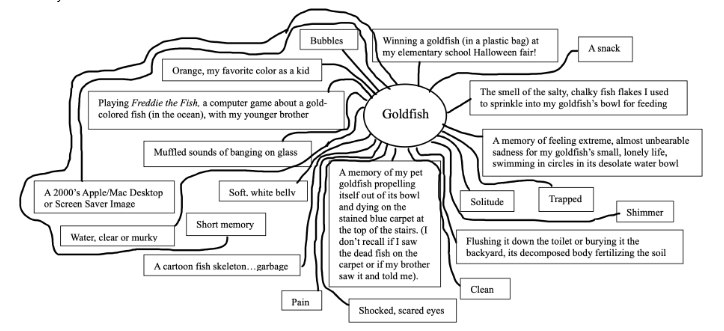
Now, if we were to use this dream in therapy, we would pause here and identify the most pertinent image of dream. In this case, the image of swallowing the goldfish or gulping the guppy feels most impactful. Before jumping to interpretations or meaning, a therapist would next help me (the dreaming client) flesh out my associations with goldfish, or swallowing, or swallowing goldfish. This could be any kind of association, including images, concepts, words, from personal memories, movies, culture etc.
See my associations below:
Why Are Personal Associations Important in Dream Interpretation?
Through this process of “incubating” my associations, I can recall various memories, images, pop-culture references or feelings that are personally conjured when pondering the symbol of a goldfish. Some of my associations include positive memories like winning a pet goldfish at my elementary school fair, or the delicious goldfish cracker I used to snack on during childhood. Other associations are more distressing or disturbing such as the powerless and isolating feeling of being trapped to the confines of a small bowl, or an upsetting memory of the same pet goldfish I won at the school fair leaping to its death out of its water bowl.
How Do Dreams Reveal Deeper Emotional Meaning?
Had I not contemplated my personal associations to goldfish, I may not have recalled the disturbing experience of my former pet goldfish catapulting itself out of its bowl to its demise–my first experience with death as a child. Perhaps this dream is about avoiding death, or maybe even the opposite, preserving life, or some specific version of it. When I look closer at my other associations, they seem to center around my childhood: The computer game I used to play with my brother as a kid, the cracker, my childhood favorite color, the cartoon fish skeleton… And from this, perhaps we can deduce that the goldfish in my dream represents my childhood self, my inner child. And if I swallow the goldfish in my dream, perhaps the dream ego is attempting to protect or preserve my inner child amidst a chaotic and transitional time. Because if it doesn’t, perhaps the dream ego is concerned that this part of me might die.
Not to get all emo on you…
How Can Dream Analysis Support Self-Discovery?
At any event, you can see how dream analysis adds a deep and colorful layer to therapeutic framework and can sometimes allow you to access parts of yourself you couldn’t quite grasp in your more realistic, logical, waking mind. Dreams, imagery, and symbols from the unconscious can guide you even closer to yourself if you pay attention to it.
If you’d like to analyze your dreams as a way to uncover your own unconscious truths and desires, schedule a consultation call with our Client Care Coordinator who can match you with a therapist who will help you decode your dreams and deepen your self-discovery in therapy.